
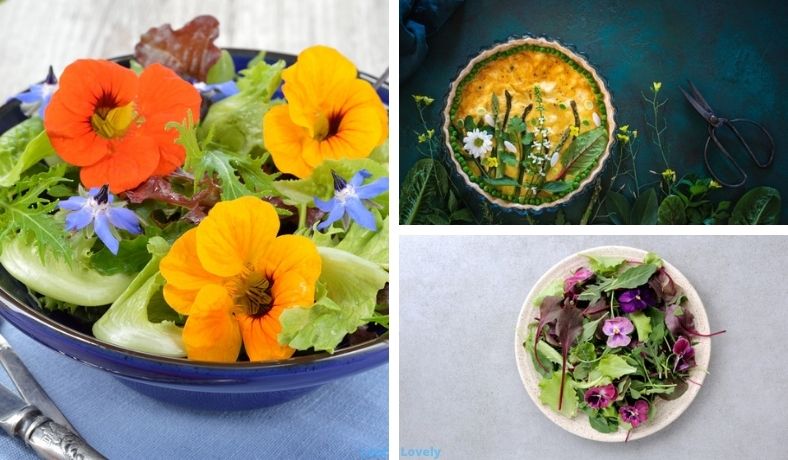
Edible flowers are becoming more and more popular in the culinary world. Not only do they add flavor and color to dishes, but they can also be used to decorate desserts and drinks as well as some other benefits.
If you’re interested in growing your edible flowers, read on to learn more!
What Are Edible Flowers? Why Would You Want To Grow Them Indoors?
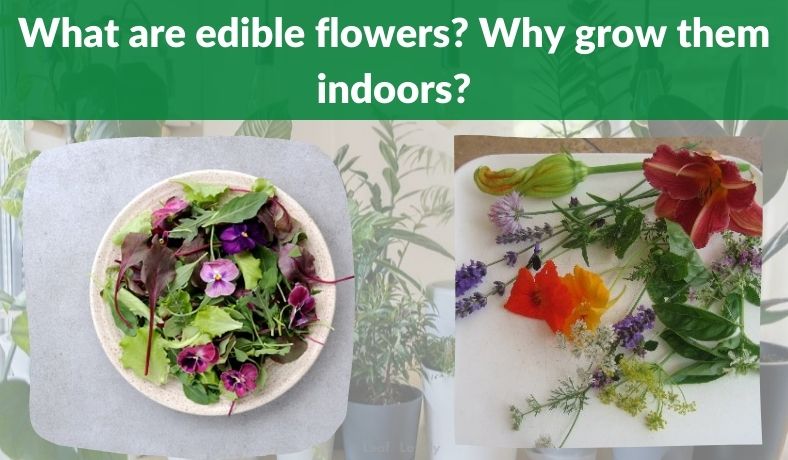
Edible flowers are simply species of flowers that can be eaten. They’re often used as a decoration on cakes and other desserts but can also be used in salads or as a garnish on savory dishes.
While you can buy edible flowers in a range of varieties like purple flowers and pink flowers, at some specialty stores, growing your own is much cheaper and more rewarding. Plus, it’s not that difficult to do!
Why grow edible flowers indoors?
There are many reasons why you might want to grow edible flowers indoors. Perhaps you want to have a constant supply of fresh, beautiful garnishes for your dishes. You can also think of growing herbs and having your own herb garden.
Or maybe you’re looking for a fun and unique way to add some color and flavor to your salads. Whatever your reasons, growing an edible flower indoors is a great way to add a little something extra to your meals.
Are all flowers ok to eat?
No – not all flowers are edible or safe to eat at the least. Many common flowers (such as tulips and lilies) are poisonous if ingested.
Before you start snacking on your bouquet, it’s important to do some research and make sure that the flowers you’re growing are safe to eat.
Edible plant / edible flower categories
In general, though, most edible flowers fall into one of two categories:
- Leafy greens
- Flowering plants.
Common leafy green edible flowers include nasturtiums, violets, and pansies. Flowering plants that are commonly used as edible flowers include roses, calendulas, and squash blossoms.
Which Flowers Are Safe To Eat? How Do You Use Them In Recipes?
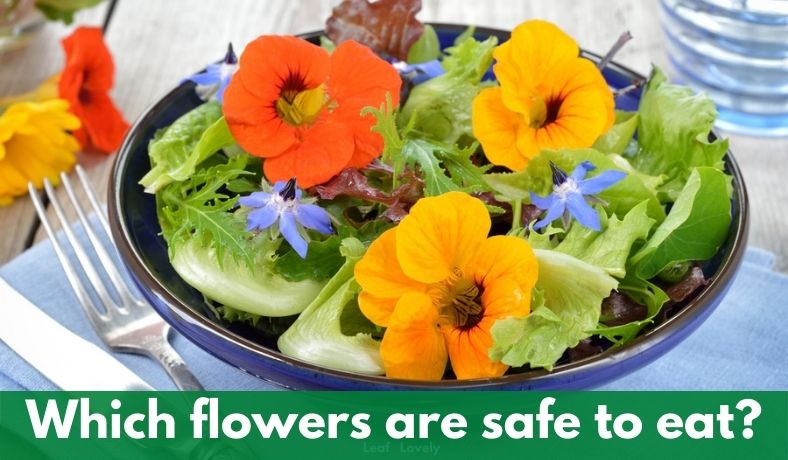
If you’re unsure about which flowers are safe to eat, a good rule of thumb is to only consume flowers that you would feel comfortable eating if they were not cooked.
Some flower types are technically edible but their petals can be quite tough and are best used for decoration. On the other hand, daisies and pansies have much more delicate petals that can easily be added to salads or used as a garnish.
When it comes to using safely edible flowers in recipes, there are no rules. You can add them to just about anything, from soups and salads to main courses and desserts.
List of flowers that are safe to eat
- Begonias
- Wax Begonias (Begonia cucullata) – Both raw and cooked leaves and flowers are edible. In most cases, they have a slightly bitter aftertaste if they’re in water.
- Tuberous Begonias (Begonia X tuberosa) – You can use the petals in salads or as a garnish. Also, stems can be substituted for rhubarb. (Note: These stems and flowers contain oxalic acid, so individuals suffering from gout, kidney stones, or rheumatism should not consume them.)
- Calendula (Calendula officinalis, Marigolds) – Only the petals are edible.
- Carnations (Dianthus caryophyllus, known as Dianthus) – You can add carnations to candy or use them as a cake decoration. Cut away the petals from the bitter white base of the flower. The petals of the carnation are one of the secret ingredients of Chartreuse, a French liqueur.
- Chrysanthemums (Chrysanthemum coronarium) – Colors range from red, white, yellow, and orange. Tangy and slightly bitter. Flavors range from a slight pepper taste to a mild cauliflower flavor. After blanching first, the petals should be sprinkled on a salad. Vinegar can also be flavored with leaves. Be sure to remove the bitter flower base and only use the petals. Leafy young varieties of Crown Daisy, which are also known as Chop Suey Greens in Japan and Shingiku in China, have wide applications in Oriental stir-fries and as salad seasonings.
- Clover (Trifolium species) – A sweetish licorice flavor with a hint of anise. As a folk medicine, white and red clover blossoms were used for gout, rheumatism, and leucorrhea. Furthermore, clover blossom tea was believed to improve the texture of the fingernails and toenails. In Native American culture, whole clover plants were used in salads, and white clover leaf tea was used to treat coughs and colds. Bitter flowers that are turning brown should be avoided; instead, choose the ones that are brightest in color. Uncooked flower heads are often difficult to digest.
- Cornflower (Centaurea cynaus) – Bachelor’s button is another name for it. It tastes somewhat sweet to spicy and has a clove flavor. It’s a natural food dye and is used mostly for garnishing.
- Dame’s Rocket (Hesperis matronalis) – Also referred to as Sweet Rocket or Dame’s Violet. Sometimes mistaken for Phlox. Dame’s Rocket has four petals, while Phlox has five. Flower colors can range from deep lavender to pink to white, and resemble phlox flowers. It belongs to the mustard family, which also includes radishes, broccoli, cabbage, cauliflower, and mustard. Flower and plant parts are edible but taste bitter. Florals are attractive and used in salads. You can use the young leaves in salads (for culinary purposes, pick these leaves before they flower). In addition, the seeds can also be sprouted and added to salad. It’s different from the herb Rocket, which is used in salads.
- Dandelions (Taraxacum officinalis) – A Daisy family member. Pick young flowers for the best taste. Sweet, honey-like flavor. The older flowers are bitter. Flowers are tastier than dandelion buds: pick these when they are tight in the center, close to the ground, and about the size of a gumball. They are tasty steamed or raw and are also used in wines. Young leaves are delicious steamed or chopped up for salads. When serving rice dishes, sprinkle petals over the rice like confetti.
- Day Lilies (Hemerocallis species) – Lightly sweet with a mild vegetable flavor, similar to sweet lettuce or melon. Similar in taste to asparagus and zucchini. If you plan to use the surprisingly sweet petals in desserts, cut them away from the white bitter base of the flower. A salad platter or a cake topped with flowers looks beautiful. You can use the large petals to dress up a spring salad. You can use asparagus shoots two or three inches tall in the spring as a substitute. (Note: Many Lilies contain alkaloids and should not be eaten. Eat in moderation as Day Lilies may act as a diuretic or laxative.)
- English Daisy (Bellis perennis) – There is a mild bitter taste to the flowers and they are used more for their appearance than for their taste. They can be used in salads and as a garnish.
- Fuchsia (Fuchsia X hybrida) – The flavor of blooms is slightly acidic. Their bright colors and graceful shapes make them an ideal garnish. You can also eat the berries.
- Garden Sorrel (Rumex acetosa) – The flowers of sorrel have a tart, lemony taste. Use it on pizza, salads, in sauces, and over cucumber salads just like you would a lemon.
- Gladiolus (Gladiolus spp) – The flowers (without anthers) taste indistinguishable (like lettuce, sort of), but they are great containers for creamy spreads or mousses. Use the flower petals in salads or in cooking like Daylilies.
- Hibiscus (Hibiscus rosa-sinensis) – A citrusy flavor with cranberry overtones. Try using a few petals sparingly in salads or as garnish. They can be dried and used to make exotic tea.
- Hollyhock (Alcea rosea) – Pretty bland tasting, not the best option.
- Honeysuckle (Lonicera japonica) – The taste is sweet and honeylike. The flowers are the only edible parts. Caution: Please do not consume any berries – they’re poisonous!
- Impatiens (Impatiens wallerana) – The flowers have a sweet flavor. They can be used as a garnish in salads or floated in drinks.
- Johnny-Jump-Ups (Viola tricolor) – The gorgeous yellow, white, and purple blooms taste mildly of wintergreen and go well with salads, cakes, and soft cheese. Also great in drinks, soups, desserts, or salads.
- Lilac (Syringa vulgaris) – Lilacs vary in flavor from plant to plant. Usually very fragrant but mildly bitter. A lemony taste with an overtone of floral and pungent flavor. It is delicious when sliced in salads and crystallized with egg whites and sugar.
- Linden (Tilla spp.) – Flowers are small, white to yellow, and fragrant, with a honey-like flavor. They have long been used as a medicine for tea. Note: Linden flower tea contains compounds that can damage the heart if ingested frequently.
- Marigold (Tagetes tenuifolia, know also as T. signata) – You can substitute marigold for saffron. Their citrus flavor makes them a great addition to salads.
- Nasturtiums Tropaeolum majus) – There are numerous varieties, all trailing or upright, with amazing sunset colors and a peppery flavor. Nasturtiums are one of the most popular edible flowers. It has a sweet, spicy flavor similar to watercress. You can stuff whole flowers with savory mousse. The leaves give salads a peppery tang. They are inexpensive alternatives to capers. As an appetizer or garnish for salads, cheese tortas, open-faced sandwiches, and platters, use the entire flowers.
- Pansy (Viola X wittrockiana) – The taste of pansies is slightly sweet and grassy. It is mildly flavored if you eat only the petals, but if you eat the whole flower, a wintery, green undertone appears. Put them on salads, desserts, or soups as garnishes.
- Phlox, Perrennial Phlox (Phlox paniculata) – Phlox perennials can be eaten, but not annuals. Phloxes growing 3 to 4 feet tall is the high-growing (taller) variety and not the low-growing (creeping) variety. It has a slightly spicy taste. Ideal for fruit salads. The flowers range from a deep reddish-purple to a pink coloring, with some white as well.
- Pineapple Guave (Feijoa sellowians) – Rather like freshly picked papaya or exotic melons still warm from the sun, the flavor is sweet and tropical.
- Primrose (Primula vulgaris) – Cowslip is another name for this plant. It is colorful and has a bland, but sweet taste. Use the flower buds in salads, pickle them, cook them as a vegetable, or ferment them into wine.
- Queen Anne’s Lace (Daucus carota) – Wild Carrot and Bishop’s Lace are other names for it. Originating from the root of the carrot, modern carrot cultivars have a light flavor and can be eaten. It grows in clusters of white, lacy flowers with flat, round tops. Perfect for salads. (NOTE: The problem with this is the fact that it resembles and closely resembles another wild plant, Wild or Poison Hemlock, which is often found in similar habitats and is known to be the most poisonous native plant of the United States. If you want to tell them apart, you can remember that Queen Anne’s Lace has a hairy stem, while Wild Hemlock has a smooth stalk, hairless, and hollow with purple spots.)
- Roses (Rosa rugosa or R. gallica officinalis) – Different flavors are produced by different types, colors, and soil conditions. The flavor is similar to strawberries and green apples. Sweet, with peppery undertones and hints of fruit and mint. There are edible roses of every color, with darker varieties having a stronger flavor. They can be used as a garnish for desserts and ice cream, or sprinkled on salads and desserts in larger sizes. Add them to ice cubes and punches as well. Floral syrups, jellies, perfumed butter, and sweet spreads are made with petals. Remember to remove the bitter white flavor from the petals.
- Scented Geraniums (Pelargonium species) – The flavor of flowers varies with the variety. You’d get lemon-scented flowers on a geranium, for example. They come in all sorts of scents, from citrus and spice to fruit and flowers, and in pinks and pastels. They’re great sprinkled on desserts, in drinks, and frozen in ice cubes. But beware: the citronelle variety may not be edible.
- Snap Dragon (Antirrhinum majus) – Garden varieties can be bland or bitter. Their flavors are determined by their type, color, and soil conditions. Not really one of the best choices for edible flowers I’d say.
- Sunflower (Helianthus annus) – The flower is best eaten in the bud stage, when it tastes like an artichoke. Upon opening, the petals can be arranged like chrysanthemums, yielding a slightly bittersweet taste. You can also steam unopened flower buds like artichokes.
- Sweet Woodruff (Galium odoratum) – It’s also called Wild Baby’s Breath. With hints of vanilla and nutty flavors, the flower flavor is sweet and grassy. Consumed in large quantities, may cause blood to thin so be careful.
- Tulip Petals (Tulipa) – Tulip petals vary in flavor, but typically taste like sweet lettuce, fresh baby peas, or cucumber. They can trigger strong allergic reactions for some people. If touching them causes a rash, numbness, or any other unpleasant feeling, don’t eat them! Never consume the bulbs. If in doubt, don’t eat the flowers.
- Violets (Viola species) – Also related flowers like Johnny jump-ups or violas. These have a somewhat sweet flavor. I recommend the soft leaves and flowers in salads as well as decorative for sweets and drinks. Their heart-shaped leaves are edible and tasty when cooked like turnip greens.
- Yucca Petals (Yucca species) – Yucca flowers are mildly sweet with a hint of artichoke. They’re great in the spring for salads and as garnish, too.
What are good ways to use edible flowers?
Get creative and experiment until you find a combination that you love! Here are a few favorites and best ways to use edible flowers:
- Scatter nasturtiums over a summer salad for a pop of color and flavor
- Add violets to homemade ice cream or sorbet for a pretty pastel hue
- Mix roses and lavender into a shortbread dough for a unique twist on a classic cookie
- Garnish a cake or cupcakes with pansies or daisies for a cheerful touch
How Do You Go Grow Edible Flowers Indoors?
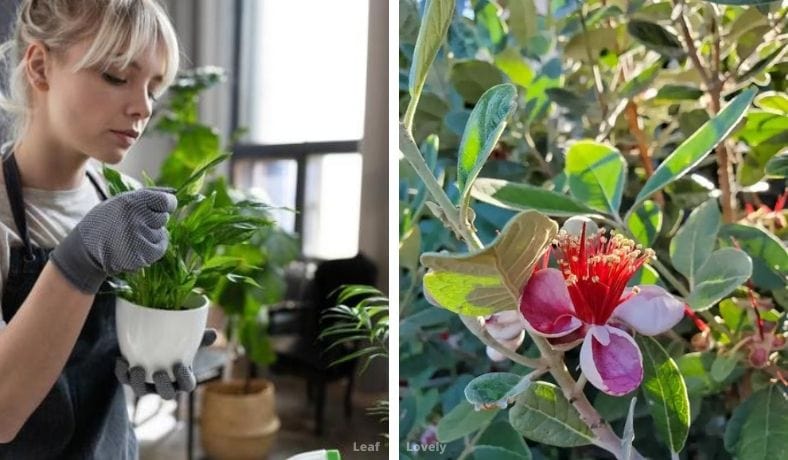
Growing edible plants isn’t hard but there are a few things you need to know first. Here’s a short guide to growing edible flowering plants indoors, from planting to harvesting:
- To start, you will need to purchase some quality edible flower seeds. You can find these at most garden centers or online.
- Once you have your seeds, it’s time to start planting! The first step is to fill some pots with soil and then plant the seeds according to the package directions.
- After the seeds have been planted, water them well and place the pots in a sunny spot. Keep an eye on the soil and water as needed so that it stays moist but not soggy.
- As the plants begin to grow, you can start fertilizing them with diluted liquid fertilizer.
- Once the plants are established and beginning to bloom, you can start harvesting the edible flowers. Simply cut the flower heads off at the stem and enjoy!
What Are The Benefits Of (And Challenges) of Growing Edible Flowers Indoors?
Here’s a basic list of the benefits (and challenges) of growing edible flowers indoors.
Benefits:
- For one, you have complete control over the growing environment, which means you can ensure that the plants receive the optimal amount of sunlight, water, and nutrients.
- Additionally, growing edible flowers indoors allows you to extend the growing season by starting plants early in the spring and continuing to harvest into late fall or winter.
- You’ll become more educated about natural alternatives to medicines, flavoring, and more! It’s a fascinating world of plants and botany.
- Growing indoor edible plants is great experience and often leads to even more plant projects and better results as you learn.
Challenges:
- One of the biggest is dealing with pests and diseases; since they’re not exposed to natural predators outdoors, indoor plants can be more vulnerable to infestations.
- Additionally, it can be difficult to provide adequate ventilation for indoor plants, which is necessary for preventing fungal diseases.
- Finally, growing edible flowers indoors requires a bit more attention and care than growing other types of plants, so be prepared to put in some extra effort!
Recipes That Use Edible Flowers
If you’re growing edible flowers indoors, you’ll likely want to use them in some recipes! Here are a few ideas to get you started:
- Toss pansies or nasturtiums in a salad for a splash of color
- Add petals from borage or roses to your favorite summertime cocktails
- Make candied violets using violet syrup and sugar
- Bake scones or cupcakes with lavender buds for a delightful flavor
The possibilities are endless when it comes to recipes that feature edible flowers. Get creative and have fun experimenting in the kitchen!
You might be surprised at how well certain blossoms complement certain dishes.
Frequently asked questions (FAQs)
Q: Are there any special considerations I need to take into account when growing edible flowers indoors?
A: Yes, there are a few things to keep in mind. First, make sure you are growing the flowers in pots or containers that can drain well.
Second, don’t use any pesticide or herbicide sprays on your plants – even if they are organic – as these can be harmful if ingested.
Finally, wash your hands after handling the plants and before eating any of the flowers.
Q: What are some of the best edible flowers to grow indoors?
A: Some great edible flowers to grow indoors include nasturtiums, violets, pansies, and calendulas.
Q: What do I need to get started?
A: All you need are some flower seeds (you can find these online or at your local gardening store), potting soil, and some pots or containers.
Q: How do I care for my indoor edible flowers?
A: Water your plants regularly and make sure they are getting enough sunlight. In terms of fertilizing, a general all-purpose fertilizer will do the trick. Just follow the instructions on the package.
Q: Can I grow edible flowers indoors year-round?
A: Yes, you can! Just remember to provide enough light for your plants during the winter months, as they will need it to thrive.
You may also want to consider growing some plants in a greenhouse or sunroom if you live in a colder climate.
Q: What are some of the best ways to use edible flowers?
A: Edible flowers can be used in all sorts of dishes, from salads and soups to desserts and main courses in daily cooking. They can also be candied or made into flower-infused oils, vinegar, and syrups.
There’s an amazing amount of creative ways to use edible flowers in cooking, sweets, and even homemade natural medicines.